
Parents spend countless hours preparing for IEP meetings, gathering evaluations, and advocating for their child’s educational needs. Yet one of the most powerful protections under the Individuals with Disabilities Education Act (IDEA) is a document many families have never heard of: Prior Written Notice (PWN).
Whether you’re requesting additional services, asking for an evaluation, or disagreeing with an IEP team’s decision, Prior Written Notice creates a written record of what the school decided—and why.
Understanding how Prior Written Notice works can help parents become stronger advocates and ensure school districts remain transparent throughout the special education process.
A Story Many Parents Can Relate To
After her son’s annual IEP meeting, Sarah felt encouraged. She had shared concerns about his continued struggles with reading and asked whether additional reading intervention could be added to his program.
The team discussed the issue, asked a few questions, and moved on to other agenda items.
A few weeks later, Sarah received the finalized IEP.
As she reviewed it, she realized no additional reading services had been added.
Even more concerning, there was no explanation of why her request had been denied.
She was left wondering:
- Did the team consider my request?
- What information did they use to make their decision?
- Were other options discussed?
- Why wasn’t my request approved?
The answers to those questions should have been provided in a document many parents have never heard of:
Prior Written Notice (PWN).
PWN is one of the most important procedural safeguards available to families, yet many parents are unaware of when they should receive it—or how valuable it can be.
What Is Prior Written Notice?
Procedural safeguards protect your right to meaningful participation in the decision-making process as an equal member of your child’s IEP team. One of the strongest procedural safeguards provided under the Individuals with Disabilities Education Act (IDEA) is Prior Written Notice (PWN).
Prior Written Notice is written documentation of a school district’s decisions regarding your child’s special education program. It promotes transparency throughout the IEP process by clearly explaining what the district proposes or refuses to do and why.
A well-written PWN creates accountability by documenting:
- What decisions were made
- What requests were approved or denied
- Why those decisions were made
- What data supported the decision
- What alternatives were considered
- Why those alternatives were rejected
Simply put, Prior Written Notice answers one important question:
What did the district decide, and why?
When Must Schools Provide Prior Written Notice?
The word “prior” can be misleading.
In most cases, families receive Prior Written Notice after an IEP meeting but before any changes to the student’s educational program are implemented.
Schools must provide Prior Written Notice whenever they propose or refuse to initiate or change your child’s:
- Identification
- Evaluation
- Eligibility
- Educational placement
- Special education services
- Related services
- Accommodations
- Supports
- Educational program
Schools must also provide Prior Written Notice whenever they propose or refuse to:
- Decide if your child is eligible for special education
- Conduct an evaluation
- Deny a requested evaluation
- Change your child’s disability category
- Change services or supports
- Change school placement
- Add, modify, or remove accommodations
- Make significant changes to your child’s educational program
One of the most important situations for parents to understand is this:
Whenever a parent requests a change that would affect their child’s special education services, supports, evaluation, placement, or program, the school district should provide Prior Written Notice explaining whether that request was approved or denied.
What Should Every Prior Written Notice Include?
Under IDEA, every Prior Written Notice must include several required components.
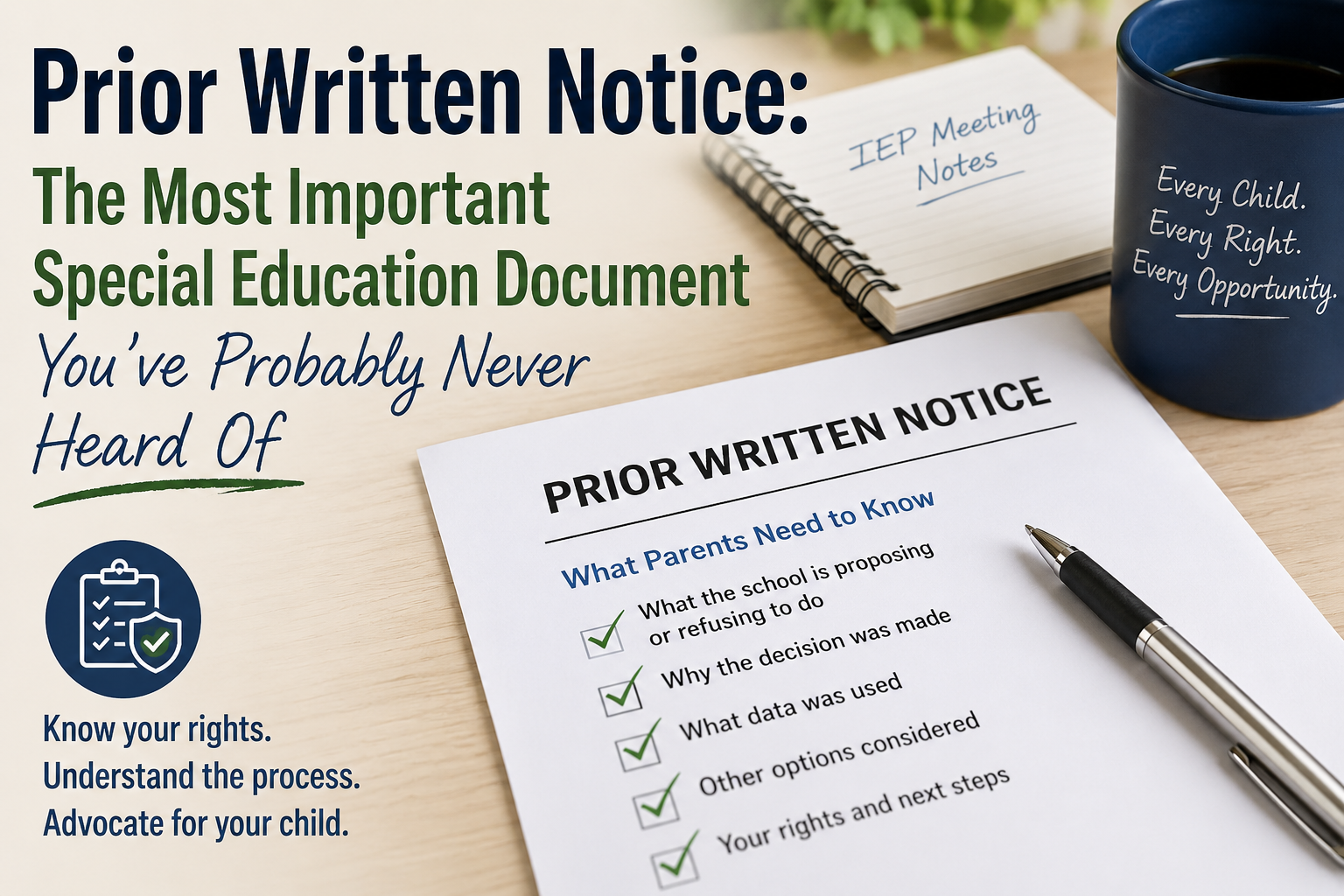
In practical terms, every PWN should answer these questions:
What is the school proposing or refusing to do?
Clearly explain the action being proposed or denied.
Why was the decision made?
Describe the reasoning behind the decision.
What information was used?
Identify the evaluations, assessments, records, observations, or other data relied upon.
What other options were considered?
Explain the alternatives the IEP team discussed and why they were rejected.
Were there any other relevant factors?
Include any additional considerations that influenced the decision.
What are the parents’ rights?
Explain the procedural safeguards available if parents disagree with the district’s decision.
Why Prior Written Notice Matters
As an advocate, I often tell families to document every important conversation as though they might someday need it in dispute resolution—not because I expect they will, but because good documentation often prevents disagreements from becoming formal disputes.
Prior Written Notice helps move conversations forward when the IEP team reaches an impasse.
Rather than continuing to debate a request or decision, parents can ask the team to document its position in a Prior Written Notice.
Once the district’s reasoning is clearly explained in writing, families are often in a much better position to evaluate their options and determine appropriate next steps.
When requests, decisions, supporting data, and reasoning are documented, misunderstandings can often be resolved before they become larger disputes.
And if disagreements do continue, everyone has a written record of what occurred and why.
You do not have to agree with every decision your child’s IEP team makes.
But you should expect every important decision to be clearly explained in writing.
If a request, decision, or disagreement is important, ask for it in writing—and ask for it to be documented in the Prior Written Notice.
What If You Disagree With Prior Written Notice?
Receiving Prior Written Notice does not mean you must agree with the district’s decision.
Instead, it provides the information you need to make informed decisions about what to do next.
Depending on the circumstances, parents may choose to:
- Request another IEP meeting
- Submit additional evaluations or documentation
- Ask follow-up questions
- Request mediation
- File a state complaint
- Request a due process hearing
Understanding the district’s reasoning allows families to advocate more effectively moving forward.
Tips for Parents
Whenever you make an important request during an IEP meeting:
- Ask that your request be documented.
- Ask whether the district is approving or denying it.
- Request Prior Written Notice if the decision affects your child’s special education program.
- Carefully review the PWN when you receive it.
- Compare it to what was actually discussed during the meeting.
Good documentation protects everyone involved.
Frequently Asked Questions About Prior Written Notice
What is Prior Written Notice in special education?
Prior Written Notice (PWN) is a written explanation required by the Individuals with Disabilities Education Act (IDEA) whenever a school proposes or refuses changes involving a child’s identification, evaluation, educational placement, eligibility, or special education services.
When should parents receive Prior Written Notice?
Parents typically receive Prior Written Notice after an IEP team makes a decision but before the district implements that decision.
Is Prior Written Notice required every time a parent makes a request?
If the request would result in a change to your child’s evaluation, eligibility, placement, services, supports, or educational program, the district generally must provide Prior Written Notice approving or denying the request.
Can parents disagree with Prior Written Notice?
Yes. Prior Written Notice explains the district’s decision, but parents have the right to disagree and pursue additional meetings, mediation, state complaints, or due process when appropriate.
Want to Learn More?
Prior Written Notice is just one of many tools families can use to become more informed and effective participants in the IEP process.
For families attending the Silver State Self-Advocacy Conference in Las Vegas on August 3–4, I’ll be presenting Navigating the IEP Process: Practical Tools for Families, where we’ll discuss Prior Written Notice along with practical strategies for reviewing records, understanding educational data, preparing for meetings, and advocating effectively throughout the special education process.
Whether or not you’re attending the conference, presentation materials, practical tools, and additional resources for families will be available after the conference at:
https://sierraspecialeducationadvocacy.com/silver-state-conf-2026
About the Author
Bonnie Klein is a non-attorney special education advocate and founder of Sierra Special Education Advocacy. She helps families navigate the IEP process, understand their rights under IDEA, and advocate effectively for students with disabilities. Bonnie also serves as an instructor for COPAA’s Special Education Advocacy Training (SEAT) program.
Learn more at SSEAdvocacy.com.