Support for California Families
Special Education Attorneys in California
When a school decision leaves you unsure whether your child’s evaluation, IEP, services, or placement is appropriate, it helps to understand the process and your options. Our legal team helps California families make sense of special education rights and available dispute-resolution paths.
Are You Dealing With Any of These Issues?
If any of these situations sound familiar, legal guidance may help you understand your options and what to do next.
Evaluation & Eligibility
A requested evaluation is refused or delayed, or you disagree with an eligibility decision.
IEP Services
Services or supports in the IEP are reduced, delayed, or not provided as written.
Placement & Program Changes
The school proposes a placement or program change that does not appear to fit your child’s needs.
Discipline & Behavior
Discipline, behavior supports, or placement raise disability-related concerns.
School Is Not Responding
Documented concerns continue without meaningful action or a clear written decision.
Formal Dispute Options
You are considering IEP Facilitation, mediation, a State Complaint, or due process.
Understanding Your Child's Special Education Rights in California
California special education is governed by IDEA together with California education law and regulations. Those protections address evaluation, eligibility, IEP development, services, placement, parent participation, procedural safeguards, and access to a free appropriate public education for eligible students.
Evaluation & Eligibility
The evaluation process should gather information needed to determine eligibility and understand the student’s educational needs.
IEP Development
For an eligible student, the IEP team develops an individualized program addressing goals, special education, related services, supports, and placement.
FAPE & LRE
Eligible students are entitled to a free appropriate public education, with placement considered in the least restrictive environment appropriate to their needs.
Procedural Safeguards
Parents have rights to notice, participation, records, independent evaluation in qualifying circumstances, and dispute-resolution procedures.
When It May Be Time to Get Legal Help
Legal guidance may be useful when an evaluation or service is delayed, an IEP is not being followed, you disagree with a placement or eligibility decision, or repeated meetings have not resolved the concern. California has multiple dispute-resolution paths, and the best option depends on the issue, timeline, records, and relief being sought.
Watch a message about getting help with special education concerns.
What Can You Do When You Disagree With the School?
California families may use informal or local alternative dispute resolution, a State compliance complaint through the California Department of Education, mediation, or due process through the Office of Administrative Hearings. These procedures are different and should not be treated as interchangeable.
IEP / Local Resolution
A reconvened IEP meeting or local alternative dispute-resolution process may help address concerns without a formal hearing when the parties can reach agreement.
State Compliance Complaint
A complaint to the California Department of Education can allege violations of federal or state special education law and is investigated through the State complaint process.
Mediation
Depending on the dispute, mediation may be available through the Office of Administrative Hearings or in connection with a State complaint. Participation is voluntary.
Due Process
A due process complaint may address identification, evaluation, placement, or the provision of FAPE and is handled through the Office of Administrative Hearings.
How Legal Support May Help Your Family
A careful legal review can help identify the decision in dispute, organize evaluations and IEP records, assess whether services are being implemented, and compare possible resolution paths. Depending on the facts and the services IEP Defenders agrees to provide, legal support may include meeting preparation, negotiations, complaints, mediation, or due process representation when appropriate.
Not Sure What to Do Next?
If your child’s evaluation, IEP services, placement, or a special education dispute has become a serious concern, connect with the California team.
Meet the California Team
Meet the attorneys who work with families on IEPs, evaluations, services, placement, and disputes.
Dylan J. Lawter, Esq.
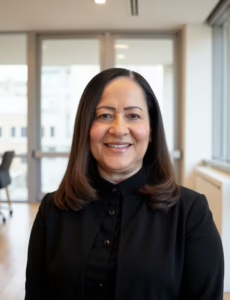
Lolita Brown Fletcher, Esq.
Sauda Johnson-McNeal, Esq.
What Families Say About IEP Defenders
Read recent feedback from families who have worked with IEP Defenders.
IEP Defenders in California
IEP Defenders
6080 Center Dr 6th Floor, Unit #686, desk 2, Los Angeles, CA 90045
California Special Education FAQs
What special education dispute options are available in California?
CDE describes State compliance complaints, mediation, and OAH due process, along with local alternative dispute-resolution options that may be available through an LEA.
Who handles California special education due process hearings?
Special education due process and mediation requests are handled through the California Office of Administrative Hearings, Special Education Division.
What is a California State compliance complaint?
It is a process through which CDE investigates allegations that an LEA or other public agency violated federal or state special education requirements, subject to the complaint procedures and timelines.
Where can California families find parent support resources?
CDE maintains information about Family Empowerment Centers, Parent Training and Information Centers, and other parent organizations serving families of children and youth with disabilities.
What if the school is not providing services in my child’s IEP?
Document the missed or changed services, keep copies of communications and progress information, and raise the issue with the IEP team. If the problem is not resolved, the appropriate next step may depend on what the IEP requires, what happened, and the remedy the family is seeking.
What if the school refuses or delays an evaluation?
Parents can raise concerns and request an evaluation when they believe a child may need special education. If the school refuses a requested evaluation, ask for the decision and reasoning in writing and review the procedural safeguards available to you. Prior Written Notice can be especially important when a district proposes or refuses an evaluation-related action.
What is the difference between a special education advocate and an attorney?
Special education advocates generally focus on the educational and IEP process, helping families prepare, understand records, and communicate with schools. Attorneys can provide legal advice and representation and may handle formal legal proceedings such as mediation or due process. Some families work with one or the other, and some situations benefit from both roles.
California Special Education Resources
These resources can help families learn more about special education rights, dispute resolution, and parent support in California.
Talk With the California Team
Have questions about your child’s IEP, evaluation, placement, services, or a special education dispute? Complete the contact form to connect with IEP Defenders and start the conversation with the California team.
Prefer to call?
743.IEP.HELP (743.437.4357)