

Author: Advocate-Paralegal Ted Scott-Smith, Reviewed by Dylan Lawter, Esq.
Most parents, reading their child’s IEP, go straight to the narrative sections and skip past the drier ones. They read present levels, goals, and the paragraphs describing strengths and needs. Those pages are in plain language and they’re about your child, so that’s where the attention goes. Then there’s a small table near the back listing the services, and because it looks clerical, most families glance at the minutes and move on.
I’ve done this myself. I’ve written hundreds of IEPs from the school side, and I’m a parent of children with IEPs, and I still catch myself reading the paragraphs closely and skimming past the table.
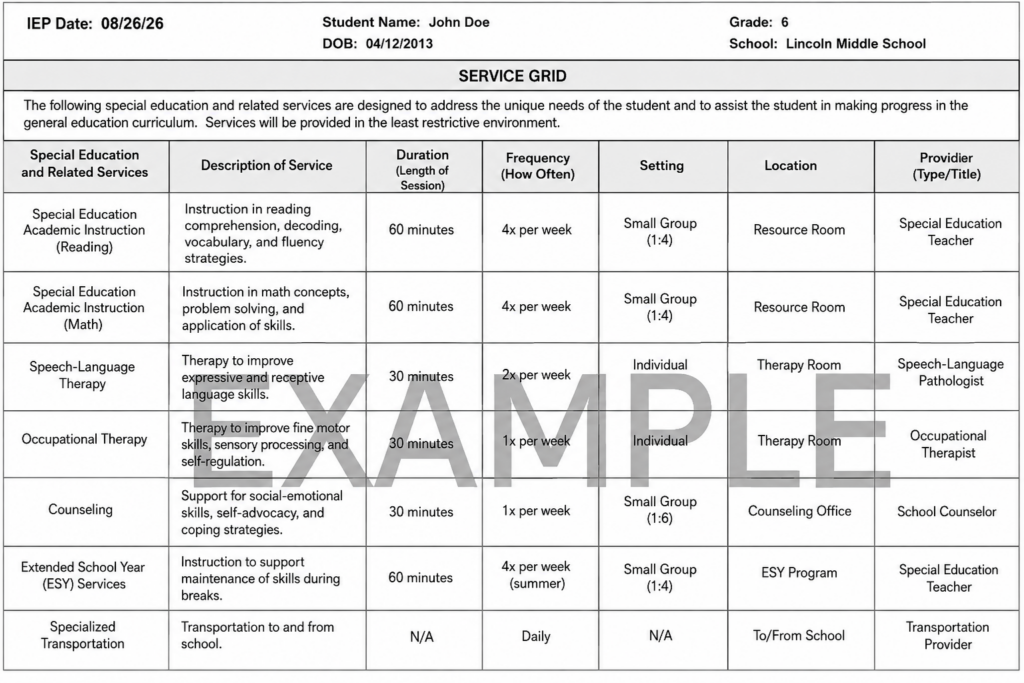
But, that table is what the school is committing to deliver, and it doesn’t only say how long, it says how often, where, in what grouping, and by whom, and every one of those shapes what your child receives.

Meet a Student Named Ellie
Ellie is in fourth grade. Her IEP includes speech-language services, and her service grid reads: Speech-language therapy: 30 minutes, 2 times per week, individual, separate setting, provided by a speech-language pathologist.
That’s five pieces of information: duration, frequency, grouping, location, and provider. Her mother knows the number she gets when she multiplies the first two, sixty minutes a week, and if someone asked what’s in Ellie’s IEP, that’s what she’d say. Most of us would say the same thing.
But that one number is where the trouble starts, because it comes out the same no matter what the other four fields say. Watch what happens when they move and sixty minutes stays right where it is.
If the Grouping Changes
Ellie’s IEP says individual, but in October her therapist begins seeing her with three other students. She’s still getting sixty minutes a week, so while on paper nothing has changed, in practice quite a lot has. In an individual session, Ellie produces target sounds almost continuously, while in a group of four she produces them for a fraction of that time and listens for the rest. Same thirty minutes, far fewer repetitions inside it.
There’s a second effect that’s easier to miss. Groups get built around shared goals when scheduling allows it and around availability when it doesn’t, so if Ellie is working on expressive language while the other three work on articulation, she gets her own goals for a few minutes and watches the others work for the rest.
If the Location Changes
The following January, sessions move out of the therapy room and over to a table in the corner of Ellie’s classroom, or the hallway just outside it. Changes like this usually have ordinary explanations: rooms get reassigned, enrollment shifts, a program moves in. But a separate setting is in that grid for a reason. Being overheard can
change what a student is willing to attempt, and for a child who’s distractible, the corner of an active classroom is where the attention goes instead of the task. The minutes on the schedule don’t change, but the conditions the session depends on do.
If the Frequency Changes
By February, scheduling has shifted again and Ellie’s two weekly sessions are consolidated into a single sixty-minute block. The weekly total hasn’t moved. What’s changed is how often she touches the skill, because two sessions give her two chances to practice and two points where her therapist can adjust based on what happened last time, while one long session gives her one of each. There’s also stamina to consider. Plenty of students are done after thirty minutes, and the last half of a sixty-minute block is not the same as the first. Frequency and duration are listed separately because they’re doing different jobs, and changing one isn’t made harmless by leaving the other alone.
Why These Changes Are Worth Questioning
Ellie’s mother could read every progress report that year, see sixty minutes a week delivered exactly as written, and still have missed three real changes to her daughter’s services. If you’re only tracking the total, none of this shows up. If you’re checking all five fields, it does.
Under the Individuals with Disabilities Education Act (IDEA), a school is required to provide the services described in a child’s IEP as they’re written. The IEP isn’t a general plan, it’s the promise, and that promise includes grouping, setting, frequency, and provider, not just the minutes. When services are consistently delivered differently than the document describes, attorneys call that a failure to implement the IEP, though I’m not an attorney and whether a particular situation rises to that level is a question for one.
The part that matters to you as a parent is simpler. These fields aren’t scheduling details the school fills in for convenience; they were decided by the IEP team, which includes you, and a change to any of them is a change to your child’s program. That applies to the fifth field too, so if the grid names a provider type, a change in who delivers the service is worth asking about for the same reason.
The Change You Agree To Without Noticing
There’s a second version of this worth watching for, and it’s the one you have the best chance of stopping before it starts.
Sometimes a grid change is proposed rather than just happening. It arrives in an amendment or a draft IEP, and the narrative around it describes peer models and collaboration with typical peers, all of which sounds great, and much of it may be true. Meanwhile one field has moved from individual to group, and a parent who reads the paragraphs and signs has agreed to a change without ever noticing one was made.
So before signing anything, compare the grid line by line against the version you have now: duration, frequency, grouping, location, provider. If any field is different, that’s a change to your child’s services and you’re entitled to understand why. You can also ask the team to document its reasoning in Prior Written Notice, which should describe what’s being proposed, why, what data supported the decision, and what other options were considered.

Tips for Parents
- Read all five fields of the service grid, not just the minutes, and write them down so you have a baseline.
- Ask where sessions are held and whether your child is seen individually or in a group. If in a group, ask what the other students are working on.
- Ask who’s delivering the service, and ask again after any staffing change.
- When an amendment or draft IEP arrives, compare the new grid against the old one field by field.
- Put questions in writing, and ask for Prior Written Notice when a change to the grid is proposed.
None of these are accusations, and most of the time the answer is a straightforward one about scheduling or coverage. The point is just to know what you’re looking at.
Frequently Asked Questions About Service Delivery
What is a service grid in an IEP?
The service grid is the section of the IEP listing the special education and related services a student receives. It typically states the duration and frequency of each service, whether it’s delivered individually or in a group, the setting, and the type of provider.
Is it a problem if my child gets the right number of minutes but in a different setting?
Possibly. The setting is written into the IEP, not decided by scheduling, so if sessions are consistently happening somewhere other than what the IEP describes, that’s worth raising with the team in writing.
Can the school change my child from individual to group services?
The district can propose a change, but any change to an IEP is a team decision, and you’re a member of that team. It belongs in a meeting with your participation, not settled informally. Ask for the reasoning and request Prior Written Notice describing the proposal.
What should I do if services aren’t being delivered as written?
Ask in writing and keep the response. Request an IEP meeting to review implementation, and ask for records showing what services were provided. Most of the time it gets resolved there, and if it doesn’t, IDEA gives families other options. It’s at that point where you might want to check in with a special education attorney.
About the Author
Ted Scott-Smith is a non-attorney special education advocate and founder of Ted Scott-Smith Special Education Consulting & Advocacy. He helps families understand what their child’s IEP actually says, identify what may be missing, and prepare for the next meeting with a clear plan.
Ted is also a special education teacher and case manager with nearly twenty years in public schools, and a parent of children with IEPs.
Learn more at tedscottsmithspecialed.com